
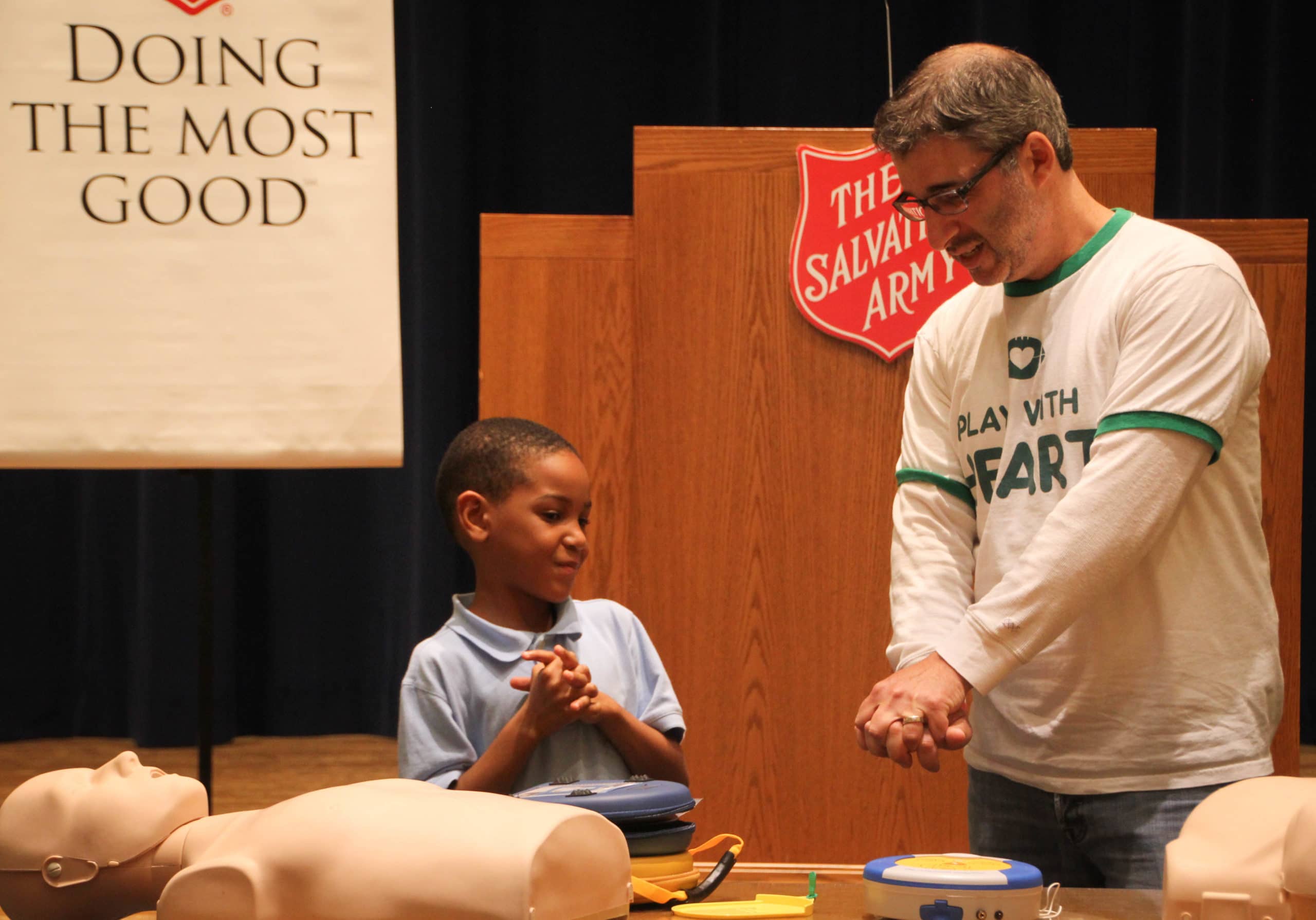
We Need a Country-Sized AED!

We need a country-sized automated external defibrillator (AED) right now. An AED is the only tool that can save someone in cardiac arrest. If needed, it delivers a lifesaving shock.

If we hooked one up to this nation, the machine would run its diagnostics (like it always does) and probably make the following statement – “Assessing society . . . assessing society . . . shock advised.”

This week is CPR/AED Awareness Week. Simon’s Heart, and others like it, are supposed to capture your attention and educate you about the importance of CPR and AED devices. It’s not up for debate. These two things – a relatively easy hand motion and a $1000 device – dramatically increase the chance of surviving sudden cardiac arrest. Without them, the chance is about 12%, which is a big deal considering sudden cardiac arrest takes the lives of 350,000 adults every year.

But I can’t. That message has to wait. Our country is hurting. Life seems to be out of control. And, if I’m being honest, heart health is a luxury. Wow, bold statement coming from a guy who lost a son to sudden cardiac arrest, has a wife who lives with a heart condition that can result in sudden cardiac arrest, and runs an organization dedicated to preventing sudden cardiac arrest and death in children.

But it is. How can we expect a mother to care about an AED device at school if the walls are crumbling and there aren’t enough textbooks? Will a father of a seemingly healthy daughter take the time to learn CPR if he lost his job and is behind on rent? Is a student athlete really going to tell his coach about his racing heart if he needs that scholarship and his parents don’t have health insurance?

Can we really expect these families to focus on cardiac arrest? Studies consistently show that the rate of sudden cardiac death is higher, and occurs at younger ages in the black community. This is a very grim statistic . . . unless you are worried about food, shelter or security.

In the United States, infant mortality is two times higher among blacks than whites. African American children are less likely to be college-ready, and more likely to be suspended than white children. African Americans are five times more likely to be incarcerated than whites. African Americans are two times more likely to be unemployed than whites, and two times more likely to live in poverty. And, let’s not forget where we were three weeks ago – African Americans are three times more likely to die from COVID-19.

Simon’s Heart cannot achieve its mission, and America cannot fulfill its promise in the face of such disparity and inequality. The tragic and senseless deaths of Ahmaud Arbery, Breonna Taylor and George Floyd are the latest symptoms that our society is very ill.

In medicine, when one function of the body is threatened, other parts of the body respond to protect and heal it. This must be our path too. We must appreciate and understand the factors that bring harm to our fellow citizens. Then, we must work tirelessly to find a cure. Not a bandaid. Not a painkiller. Not a treatment. A cure.

There are very few instances where our body can function without all parts in working order. I don’t know how many times we need to be reminded that society works the same way. Relationships, friendships, workplaces, sports teams, schools and communities all fare better when everyone feels valued and secure.

Simon’s Heart will continue to do its small part to create a more just and equal society by bringing AED devices and heart screenings to underserved communities where kids learn and play. But our focus is narrow, so we’ll look to these organizations for perspective as we work to restore the collective health of this great country.

Respectfully,
Darren Sudman
CEO, Co-Founder
& Simon’s Dad

“It is not your responsibility to finish the work [of perfecting the world], but you are not free to desist from it either.” Pirkei Avot 2:16

Criminal Justice Reform
Institute for Community Justice (Philly)
The Sentencing Project (National)

Police Conduct
Campaign Zero (National)
NOBLE (National)

Education Inequality
Stepping Stones (Philly)
The Education Trust  (National)

Food Insecurity
Philadbundance (Philly)
No Kid Hungry (National)

Infant Mortality
National Birth Equity Collaborative (National)

Social Justice
Black Lives Matter (National)

Forbes Magazine has compiled a list of resources that promote empathy and understanding around the issues of racism and inequality.


Jake Berman

“I attended a heart screening at Colonial Middle School when I was ten. I was in the marching band and liked to hike and rock climb. I was diagnosed with Wolff Parkinson White Syndrome. After my procedure, I kept doing the same things.”

Whitney Jones

Whitney’s commitment to heart health advocacy began at 10 years old when she and her mother, Rayna, were diagnosed with Long QT Syndrome during a Simon’s Heart screening at Downingtown West High School. Despite the diagnosis, Whitney pursued her passion for cheerleading and continued to thrive in the sport through her college years at St. Joseph’s University. After graduating, Whitney joined Stryker Instruments as the Senior Specialist for Off-Site Meeting and Events, where she skillfully orchestrates events that promote health and medical innovation. Further extending her impact, Whitney is an active member of the Simon’s Heart Young Professionals Committee, while her mother Rayna contributes her expertise on the Board of Directors.

Katie Asper

“I attended a heart screening at Upper Dublin High School when I was ten. I played soccer. I was diagnosed with Wolff Parkinson White Syndrome and had an ablation to fix the problem. I attend Temple University.”

Matthew Green

“I attended a heart screening in Mason, Ohio, when I was ten. I participated in baseball, basketball, and diving. I was diagnosed with an atrial septal defect. I had surgery to repair the hole and started wearing a protective shirt during activity. I am graduating from Miami University.”

Valerie Krawitz

“I attended a heart screening at Colonial Middle School when I was ten. I played baseball, soccer, and track. I was diagnosed with Long QT Syndrome and an atrial septal defect. I had heart surgery to repair the hole and I take medicine for the Long QT. I can’t play competitive sports like I once did, but found other activities. Next year, I’m attending Penn State University.”

Drew Harrington

“I attended a heart screening at Radnor High School when I was ten. I played lacrosse, tennis, and basketball. I was diagnosed with Wolff Parkinson White Syndrome. I used to feel my heart beat really fast, but just assumed it was fine. Coincidentally, on Simon’s 7th birthday, I had a procedure called an ablation. Today, my heart is fine and I attend the University of Richmond.”

Alaysia Keeley

“I attended a heart screening at Norristown High School when I was ten. I played softball and enjoyed going to the mall with my friends. I was diagnosed with Long QT Syndrome. I had to stop playing sports and drinking soda. Now, I take medication and live a normal life.”

Kyle McCabe

“I attended a heart screening at Norristown High School when I was ten. I played baseball, basketball, and football. I was diagnosed with Long QT Syndrome. I stopped playing sports to protect my heart, but I still manage to have fun.”

Melissa Fair

“I attended a heart screening at Colonial Middle School when I was ten. I loved dancing and hanging out with my friends. I was diagnosed with Partial Anomolous Pulmonary Venous Return and Atrial Septal Defect. The doctor told me that my life would have been cut short if I hadn’t found out. I’m graduating from Penn State University this year.”

Zach Steffens

“I attended a heart screening at Stillman Elementary School in Tenafly, N.J., when I was fourteen years old. I love running, Tae Kwon Do, and Armenian cultural dancing. I was diagnosed with a rare congenital defect called ALCAPA (Anomalous Left Coronary Artery from the Pulmonary Artery). I had open-heart surgery and recovered well. One month later, I suffered a cardiac arrest and an automated external defibrillator (AED) saved my life. I now have an implantable cardioverter defibrillator (ICD) and am healthier than ever. I will be attending The College of New Jersey and majoring in biomedical engineering.”

Annie FitzPatrick

“I went into sudden cardiac arrest at a local convenience store when I was 19 years old. My heart stopped and the only reason I am alive today is because an AED was readily available. I was diagnosed with Long QT Syndrome shortly after and was introduced to Darren and Phyllis with Simon’s Heart. I have been an active volunteer ever since. I went on to graduate Cum Laude from Drexel University with a double major in Business Analytics and Marketing and now work at a leading chemical company.”

Maeve Quinn

"I had a sudden cardiac arrest during softball tryouts at my high school. I was 15 years old. Thanks to the quick thinking of my coach and athletic trainer, they started doing CPR and using an AED immediately. This helped save my life. I had an implantable defibrillator surgically placed in case this happens again. I volunteer to educate people on the importance of screenings, learning CPR and the use of AEDs. Anyone can save a life like mine! I am planning on going to college for nursing."