
Hypertrophic Cardiomyopathy

Last updated: 7/10/26
Author(s): Irene Kim
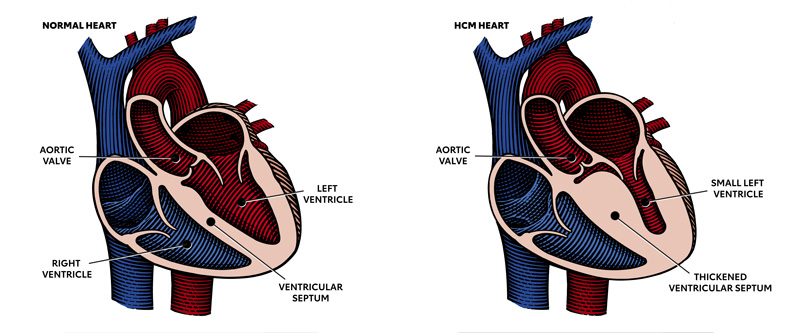
Source: American Heart Association (Hypertrophic Cardiomyopathy)

What is hypertrophic cardiomyopathy?

Hypertrophic cardiomyopathy (HCM) is a disease that affects the heart muscle. HCM is a genetic condition that runs in families, meaning it can be passed down from parents to their children. In people with HCM, changes (mutations) in certain genes cause the wall of the heart to become abnormally thick.1,2 

What causes hypertrophic cardiomyopathy?

In HCM, the thickened heart wall is less flexible and is less able to be filled up with blood. This reduces the amount of blood that can be pumped from the left side of the heart to the rest of the body (3-5). When the thickened heart walls cause obstruction to blood trying to leave the heart, the disease is classified as obstructive, or hypertrophic obstructive cardiomyopathy (HOCM) (4,5). Approximately two-thirds of patients with HCM have this obstructive type (4,5).

How common is hypertrophic cardiomyopathy?

Around 1 in 500 people in the United States are estimated to have HCM. Hypertrophic cardiomyopathy is uncommon in children, occurring in about 1 in 100,000 children.3 However, it is one of the most common inherited heart diseases and an important cause of sudden cardiac arrest in young people. It is also one of the leading causes of sudden cardiac death in young athletes.1 

What are the signs and symptoms of hypertrophic cardiomyopathy?

Most of the signs and symptoms of HCM are caused by obstruction of outflowing blood from the heart4-6. Understanding and recognizing the signs of HCM can prompt early screening and diagnosis, leading to earlier relief from symptoms and prevention of more serious consequences.

Signs and symptoms of HCM include:4-6

  • Shortness of breath, especially with physical exertion
  • Chest pain, especially with physical exertion
  • Palpitations or abnormal heart rhythms
  • Lightheadedness
  • Loss of consciousness
  • Swelling in the lower body (i.e., ankles, feet, legs) or in the veins of the neck

Who should be screened for hypertrophic cardiomyopathy?

Once a diagnosis of HCM is made, it is important that first-degree relatives (parents, siblings, and children) undergo screening because HCM is most often an inherited genetic condition.2-4 If a disease-causing genetic variant is present, each biological child has a 50% chance of inheriting that variant.2 HCM can be present even in people without symptoms, and its severity can vary widely, even among members of the same family.2-4 Because HCM may not cause symptoms for many years, some people are diagnosed only after screening because of a family history or after an abnormal heart test. This is why screening of first-degree relatives is so important.4

What are the long-term effects of hypertrophic cardiomyopathy?

Although many people with HCM live normal, healthy lives, untreated or poorly controlled HCM can increase the risk of complications over time. These may include abnormal heart rhythms (arrhythmias), heart failure (when the heart cannot pump enough blood to meet the body’s needs), stroke (when certain heart rhythm abnormalities are present), and sudden cardiac arrest.4-6

How is hypertrophic cardiomyopathy treated?

It is important for patients with HCM to: 4-7

  • Stay physically active as recommended by their healthcare team
  • Eat a heart-healthy diet
  • Avoid smoking
  • Limit alcohol consumption
  • Stay well hydrated
  • Maintain healthy weight, blood pressure, and cholesterol levels

In the past, athletes with HCM were routinely advised to avoid intense exercise and competitive sports. Today, advances in our understanding of HCM have shown that some individuals may be able to safely participate in competitive sports after early diagnosis, a comprehensive risk assessment, and shared decision-making with an HCM specialist or sports cardiologist. For these athletes, an individualized return-to-play plan and ongoing follow-up are essential.8

People with HCM who do not have symptoms may not require medication but should continue regular follow-up with their healthcare provider.4,7 Medications used to treat HCM symptoms may include: 4,7

  • Beta blockers
  • Calcium channel blockers
  • Medications that help control abnormal heart rhythms (ex: Disopyramide)
  • Myosin inhibitors (ex: Mavacamten)

For people with severe obstructive HCM whose symptoms do not improve with medication, procedures or surgery may be recommended to reduce the thickened heart muscle and improve blood flow. Some patients at high risk for life-threatening abnormal heart rhythms may also benefit from an implantable cardioverter-defibrillator (ICD), a device placed under the skin that can detect and treat dangerous heart rhythms.7

Summary

Although HCM is a lifelong heart condition, most people with HCM can live normal, active lives with appropriate medical care. Early diagnosis, comprehensive risk assessment by an HCM specialist, regular follow-up, and individualized treatment can help manage symptoms and reduce the risk of serious complications. For some people with HCM, this approach may even allow safe participation in competitive sports through shared decision-making and an individualized return-to-play plan.8 

References:

  1. Bickel T, Gunasekaran P, Murtaza G, Gopinathannair R, Gunda S, Lakkireddy D. Sudden cardiac death in famous athletes, lessons learned, heterogeneity in expert recommendations and pitfalls of contemporary screening strategies. J Atr Fibrillation. 2019;12(4):2193. doi:10.4022/jafib.2193
  2. American Heart Association. Genetic testing for hypertrophic cardiomyopathy. Accessed April 19, 2026. https://www.heart.org/en/health-topics/cardiomyopathy/understand-your-risk-for-cardiomyopathy/genetic-testing-for-hcm
  3. Lipshultz SE, Sleeper LA, Towbin JA, et al. The incidence of pediatric cardiomyopathy in two regions of the United States. N Engl J Med. 2003;348(17):1647-1655. doi:10.1056/NEJMoa021715
  4. American Heart Association. Hypertrophic cardiomyopathy (HCM). Updated 2024. Accessed April 19, 2026. https://www.heart.org/en/health-topics/cardiomyopathy/what-is-cardiomyopathy-in-adults/hypertrophic-cardiomyopathy
  5. Nishimura RA, Seggewiss H, Schaff HV. Hypertrophic obstructive cardiomyopathy. Circ Res. 2017;121(7):771-783. doi:10.1161/CIRCRESAHA.116.309348
  6. Veselka J, Anavekar NS, Charron P. Hypertrophic obstructive cardiomyopathy. Lancet. 2017;389(10075):1253-1267. doi:10.1016/S0140-6736(16)31321-6
  7. Massera D, Sherrid MV, Scheinerman JA, Swistel DG, Razzouk L. Medical, surgical, and interventional management of hypertrophic cardiomyopathy. Circ Cardiovasc Interv. 2025;18(3). doi:10.1161/CIRCINTERVENTIONS.124.014023
  8. Ommen SR, Ho CY, Asif IM, et al. 2024 AHA/ACC/AMSSM/HRS/PACES/SCMR guideline for the management of hypertrophic cardiomyopathy: a report of the American Heart Association/American College of Cardiology Joint Committee on Clinical Practice Guidelines. Circulation. 2024;149(23):e1239-e1311. doi:10.1161/CIR.0000000000001250

Simon's Fund (dba Simon's Heart) is a 501(c)(3) nonprofit organization. Contributions are tax-deductible to the extent permitted by law.
Website powered by Hopeworks Technology Solutions

Jake Berman

“I attended a heart screening at Colonial Middle School when I was ten. I was in the marching band and liked to hike and rock climb. I was diagnosed with Wolff Parkinson White Syndrome. After my procedure, I kept doing the same things.”

Whitney Jones

Whitney’s commitment to heart health advocacy began at 10 years old when she and her mother, Rayna, were diagnosed with Long QT Syndrome during a Simon’s Heart screening at Downingtown West High School. Despite the diagnosis, Whitney pursued her passion for cheerleading and continued to thrive in the sport through her college years at St. Joseph’s University. After graduating, Whitney joined Stryker Instruments as the Senior Specialist for Off-Site Meeting and Events, where she skillfully orchestrates events that promote health and medical innovation. Further extending her impact, Whitney is an active member of the Simon’s Heart Young Professionals Committee, while her mother Rayna contributes her expertise on the Board of Directors.

Katie Asper

“I attended a heart screening at Upper Dublin High School when I was ten. I played soccer. I was diagnosed with Wolff Parkinson White Syndrome and had an ablation to fix the problem. I attend Temple University.”

Matthew Green

“I attended a heart screening in Mason, Ohio, when I was ten. I participated in baseball, basketball, and diving. I was diagnosed with an atrial septal defect. I had surgery to repair the hole and started wearing a protective shirt during activity. I am graduating from Miami University.”

Valerie Krawitz

“I attended a heart screening at Colonial Middle School when I was ten. I played baseball, soccer, and track. I was diagnosed with Long QT Syndrome and an atrial septal defect. I had heart surgery to repair the hole and I take medicine for the Long QT. I can’t play competitive sports like I once did, but found other activities. Next year, I’m attending Penn State University.”

Drew Harrington

“I attended a heart screening at Radnor High School when I was ten. I played lacrosse, tennis, and basketball. I was diagnosed with Wolff Parkinson White Syndrome. I used to feel my heart beat really fast, but just assumed it was fine. Coincidentally, on Simon’s 7th birthday, I had a procedure called an ablation. Today, my heart is fine and I attend the University of Richmond.”

Alaysia Keeley

“I attended a heart screening at Norristown High School when I was ten. I played softball and enjoyed going to the mall with my friends. I was diagnosed with Long QT Syndrome. I had to stop playing sports and drinking soda. Now, I take medication and live a normal life.”

Kyle McCabe

“I attended a heart screening at Norristown High School when I was ten. I played baseball, basketball, and football. I was diagnosed with Long QT Syndrome. I stopped playing sports to protect my heart, but I still manage to have fun.”

Melissa Fair

“I attended a heart screening at Colonial Middle School when I was ten. I loved dancing and hanging out with my friends. I was diagnosed with Partial Anomolous Pulmonary Venous Return and Atrial Septal Defect. The doctor told me that my life would have been cut short if I hadn’t found out. I’m graduating from Penn State University this year.”

Zach Steffens

“I attended a heart screening at Stillman Elementary School in Tenafly, N.J., when I was fourteen years old. I love running, Tae Kwon Do, and Armenian cultural dancing. I was diagnosed with a rare congenital defect called ALCAPA (Anomalous Left Coronary Artery from the Pulmonary Artery). I had open-heart surgery and recovered well. One month later, I suffered a cardiac arrest and an automated external defibrillator (AED) saved my life. I now have an implantable cardioverter defibrillator (ICD) and am healthier than ever. I will be attending The College of New Jersey and majoring in biomedical engineering.”

Annie FitzPatrick

“I went into sudden cardiac arrest at a local convenience store when I was 19 years old. My heart stopped and the only reason I am alive today is because an AED was readily available. I was diagnosed with Long QT Syndrome shortly after and was introduced to Darren and Phyllis with Simon’s Heart. I have been an active volunteer ever since. I went on to graduate Cum Laude from Drexel University with a double major in Business Analytics and Marketing and now work at a leading chemical company.”

Maeve Quinn

"I had a sudden cardiac arrest during softball tryouts at my high school. I was 15 years old. Thanks to the quick thinking of my coach and athletic trainer, they started doing CPR and using an AED immediately. This helped save my life. I had an implantable defibrillator surgically placed in case this happens again. I volunteer to educate people on the importance of screenings, learning CPR and the use of AEDs. Anyone can save a life like mine! I am planning on going to college for nursing."