
Curiosity and Heart Screenings

This article appeared in Medpage Today.

Are physicians in Europe more curious than physicians in the United States? I get that impression after reading headlines from the recent study about soccer players and heart screenings in England:

In fact, many local reactions to this study, and the heart screening studies before it, have become very predictable. They are quick to raise doubts and cast judgments, like “screening fails to predict most heart deaths.” As a parent, patient, and advocate, I find these reactions to be very … curious.

Curiosity has played a tremendous role in my life. My son died 13 years ago. Everyone assumed it was sudden infant death syndrome (SIDS). However, our pediatrician was curious. She said, “Get your hearts checked, because babies just don’t die.” As a result, Phyllis, Simon’s mom, was diagnosed with Long QT syndrome. Long QT has been linked to up to 15% of all SIDS deaths and is one of several conditions that lead to sudden cardiac arrest in children.

If we’re open to it, this study raises some great questions and reveals some areas for improvement. Here are a few that jumped out at me:

  • The status quo does not work. The physical and survey missed 93% of the heart conditions that can lead to sudden death and 67% of other heart conditions. In other words, there were hundreds of false negatives (of the 11,168 young athletes screened). Can the ECG and/or echo help us screen better and decrease the number of false negatives?
  • The leading cause of death of adults in this country is cardiac arrest. The screening found a total of 267 heart conditions. Some were more serious than others. Won’t detecting these conditions early in life lead to better quality of life and lower healthcare costs?
  • Despite detecting 267 heart conditions, the screening failed to detect six. Some conditions take time to develop. Why? Could screening help us better understand when and why these heart conditions develop?
  • No one knows the real cost of screenings. The healthcare system is broken and pricing is erratic. Heart screenings are new. Today, we order lots of tests to learn the difference between abnormal and normal variance. Won’t the frequency and cost of additional tests decrease over time as we get smarter?
  • Six young athletes died after their conditions went undetected. Two others died after ignoring their doctor’s advice. Forty were treated and have not died. How many deaths may have been prevented from this screening? Could a second screening at a later date have prevented the six deaths? Is there a best time to screen?
  • There are two ways to prevent sudden cardiac death – detection and preparation. Screening helps to identify the conditions. CPR and automated external defibrillator (AED) devices reduce sudden death. We’re never asked to choose smoke detectors or fire extinguishers, so why should we have to choose between ECG and AED?

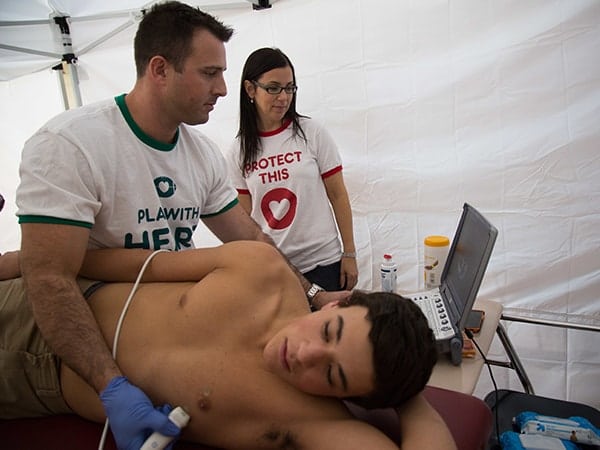
I’m biased. My son died from an undetected heart condition. My organization, Simon’s Heart, has helped students discover heart conditions. Parents have thanked me for saving their child’s life. But, even I don’t reach a conclusion from this study. I remain curious. How many students really die from undetected heart conditions? How many kids saved with an AED device were cleared during a wellness check or sports physical? What is the best way to screen kids to prevent sudden cardiac arrest? I hope that you’ll remain curious too.

Jake Berman

“I attended a heart screening at Colonial Middle School when I was ten. I was in the marching band and liked to hike and rock climb. I was diagnosed with Wolff Parkinson White Syndrome. After my procedure, I kept doing the same things.”

Whitney Jones

Whitney’s commitment to heart health advocacy began at 10 years old when she and her mother, Rayna, were diagnosed with Long QT Syndrome during a Simon’s Heart screening at Downingtown West High School. Despite the diagnosis, Whitney pursued her passion for cheerleading and continued to thrive in the sport through her college years at St. Joseph’s University. After graduating, Whitney joined Stryker Instruments as the Senior Specialist for Off-Site Meeting and Events, where she skillfully orchestrates events that promote health and medical innovation. Further extending her impact, Whitney is an active member of the Simon’s Heart Young Professionals Committee, while her mother Rayna contributes her expertise on the Board of Directors.

Katie Asper

“I attended a heart screening at Upper Dublin High School when I was ten. I played soccer. I was diagnosed with Wolff Parkinson White Syndrome and had an ablation to fix the problem. I attend Temple University.”

Matthew Green

“I attended a heart screening in Mason, Ohio, when I was ten. I participated in baseball, basketball, and diving. I was diagnosed with an atrial septal defect. I had surgery to repair the hole and started wearing a protective shirt during activity. I am graduating from Miami University.”

Valerie Krawitz

“I attended a heart screening at Colonial Middle School when I was ten. I played baseball, soccer, and track. I was diagnosed with Long QT Syndrome and an atrial septal defect. I had heart surgery to repair the hole and I take medicine for the Long QT. I can’t play competitive sports like I once did, but found other activities. Next year, I’m attending Penn State University.”

Drew Harrington

“I attended a heart screening at Radnor High School when I was ten. I played lacrosse, tennis, and basketball. I was diagnosed with Wolff Parkinson White Syndrome. I used to feel my heart beat really fast, but just assumed it was fine. Coincidentally, on Simon’s 7th birthday, I had a procedure called an ablation. Today, my heart is fine and I attend the University of Richmond.”

Alaysia Keeley

“I attended a heart screening at Norristown High School when I was ten. I played softball and enjoyed going to the mall with my friends. I was diagnosed with Long QT Syndrome. I had to stop playing sports and drinking soda. Now, I take medication and live a normal life.”

Kyle McCabe

“I attended a heart screening at Norristown High School when I was ten. I played baseball, basketball, and football. I was diagnosed with Long QT Syndrome. I stopped playing sports to protect my heart, but I still manage to have fun.”

Melissa Fair

“I attended a heart screening at Colonial Middle School when I was ten. I loved dancing and hanging out with my friends. I was diagnosed with Partial Anomolous Pulmonary Venous Return and Atrial Septal Defect. The doctor told me that my life would have been cut short if I hadn’t found out. I’m graduating from Penn State University this year.”

Zach Steffens

“I attended a heart screening at Stillman Elementary School in Tenafly, N.J., when I was fourteen years old. I love running, Tae Kwon Do, and Armenian cultural dancing. I was diagnosed with a rare congenital defect called ALCAPA (Anomalous Left Coronary Artery from the Pulmonary Artery). I had open-heart surgery and recovered well. One month later, I suffered a cardiac arrest and an automated external defibrillator (AED) saved my life. I now have an implantable cardioverter defibrillator (ICD) and am healthier than ever. I will be attending The College of New Jersey and majoring in biomedical engineering.”

Annie FitzPatrick

“I went into sudden cardiac arrest at a local convenience store when I was 19 years old. My heart stopped and the only reason I am alive today is because an AED was readily available. I was diagnosed with Long QT Syndrome shortly after and was introduced to Darren and Phyllis with Simon’s Heart. I have been an active volunteer ever since. I went on to graduate Cum Laude from Drexel University with a double major in Business Analytics and Marketing and now work at a leading chemical company.”

Maeve Quinn

"I had a sudden cardiac arrest during softball tryouts at my high school. I was 15 years old. Thanks to the quick thinking of my coach and athletic trainer, they started doing CPR and using an AED immediately. This helped save my life. I had an implantable defibrillator surgically placed in case this happens again. I volunteer to educate people on the importance of screenings, learning CPR and the use of AEDs. Anyone can save a life like mine! I am planning on going to college for nursing."